6 Mounting Tips to Mount a Staghorn Fern Indoors
The steps for mounting a staghorn fern indoors begin with understanding the epiphytic nature of Platycerium species. These ferns evolved to anchor themselves to tree bark in tropical and subtropical forests, drawing moisture from air and minimal nutrients from organic debris trapped in their basal fronds. When you bring this adaptation into a home environment, replicating the vertical growing habit transforms both the plant's health and your interior space. Successful mounting requires attention to substrate composition, structural support, and long-term water management that honors the fern's natural auxin distribution patterns.
Materials
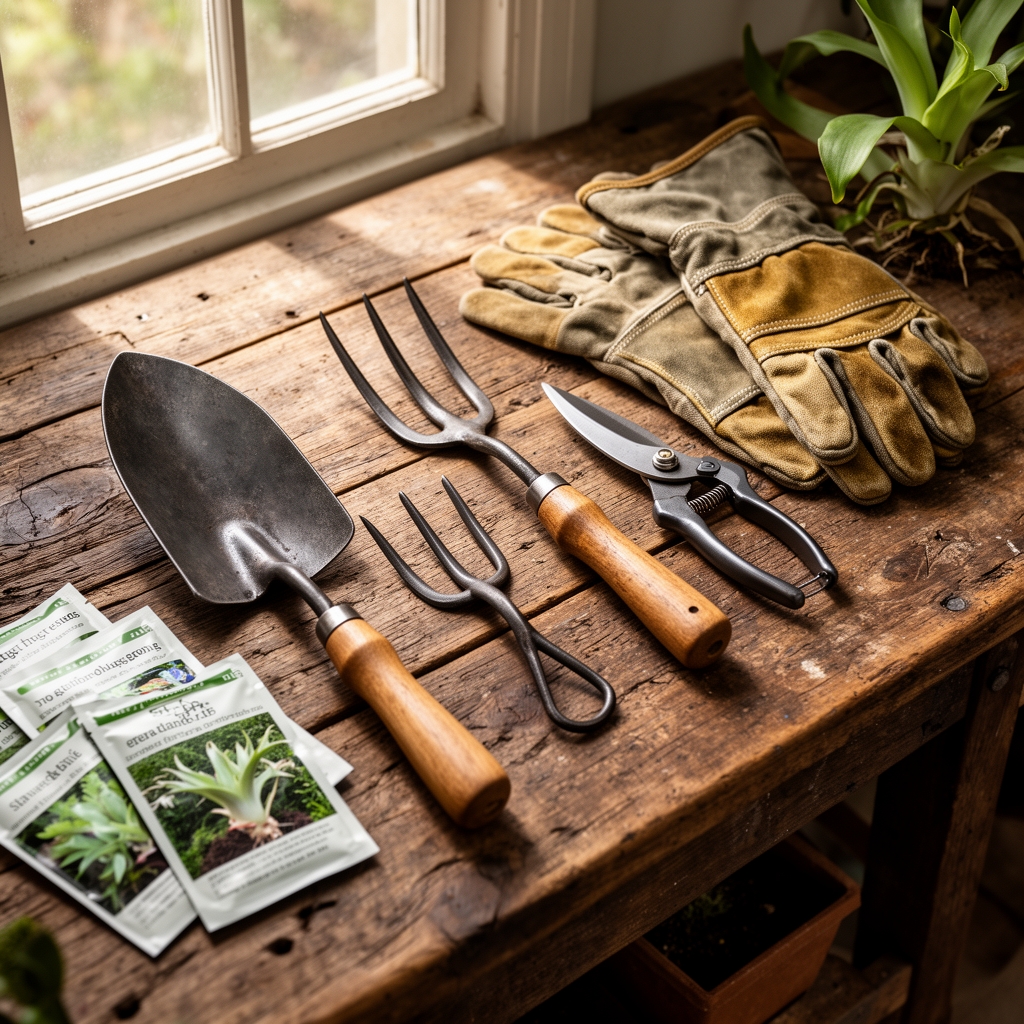
The mounting substrate must balance moisture retention with aeration. Sphagnum moss (pH 4.0-5.0) serves as the primary medium, holding water without compacting. Long-fiber sphagnum outperforms milled peat because it maintains structure for three to five years before breaking down. Layer 2-3 inches of moistened sphagnum directly against the mounting board.
Organic amendments should deliver slow-release nutrition. A 4-4-4 NPK ratio from composted bark or alfalfa meal supports steady frond production without salt accumulation. Apply 1 tablespoon per square foot of mounting surface annually. Avoid synthetic fertilizers above 10-10-10, as concentrated salts damage the delicate root system and reduce cation exchange capacity in the moss layer.
The mounting board itself determines longevity. Cedar or rot-resistant hardwood planks (1 inch thick, 12-18 inches wide) provide stable anchoring points. Cork bark slabs offer superior breathability and natural texture but cost more per square foot. Drill pilot holes for galvanized wire or rust-proof screws before assembly.
Fastening materials include 18-gauge galvanized wire, monofilament fishing line (30-pound test), or cotton twine. Avoid copper wire, which leaches phytotoxic ions as it oxidizes. Synthetic materials outlast natural fibers but require cutting away during future remounting.
Timing
Indoor mounting proceeds year-round in climate-controlled environments, but aligning the project with natural growth cycles improves establishment rates. In USDA Hardiness Zones 9-11, where outdoor cultivation is possible, late spring mounting (after final frost dates in March-April) allows the plant to acclimate during peak photosynthetic months. For strictly indoor cultivation, mount between February and June when lengthening photoperiods trigger active root growth.
Avoid mounting during dormancy (November-January in the Northern Hemisphere). Reduced transpiration rates during short-day periods slow the formation of holdfasts, the modified roots that anchor fronds to substrates. The plant invests minimal energy in new tissue when day length drops below 10 hours.
Phases
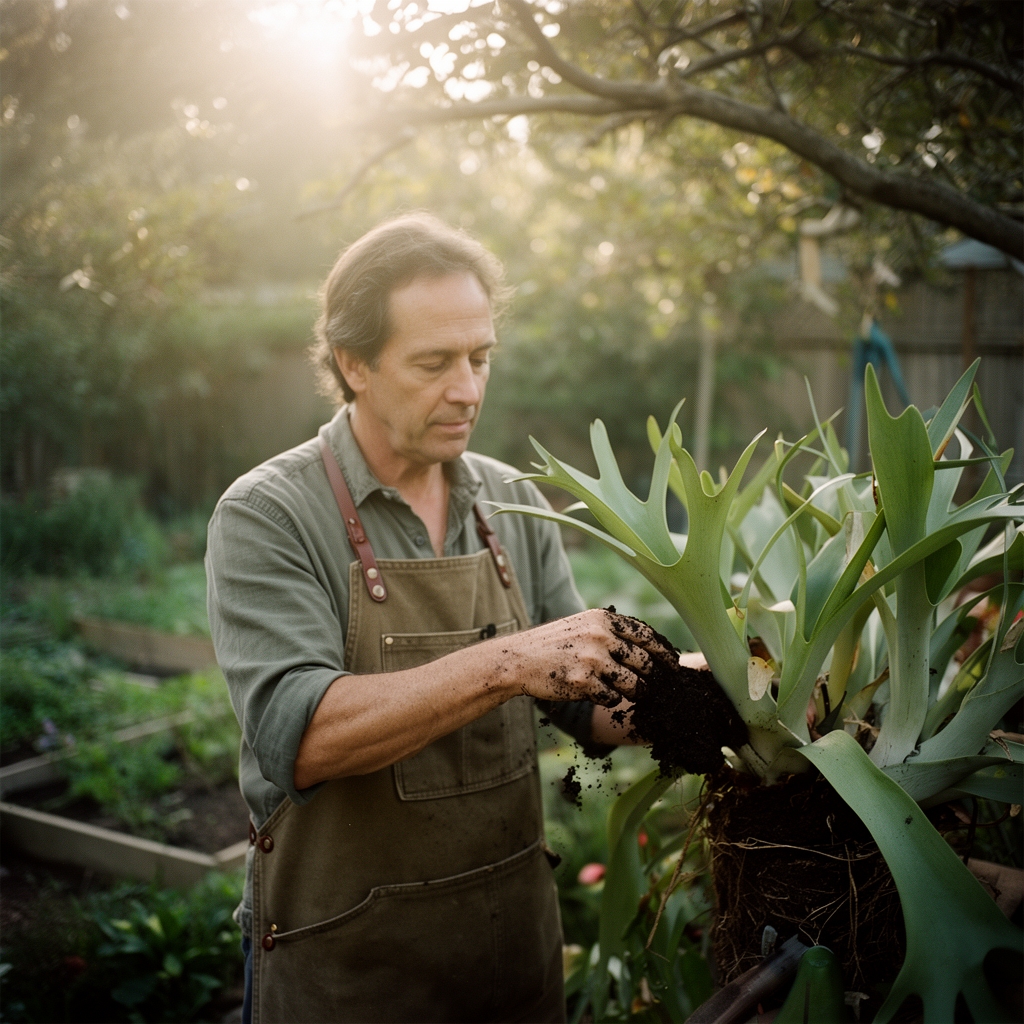
Preparation Phase: Remove the staghorn from its nursery pot. Gently tease away loose potting mix from the root ball, preserving intact holdfasts. Soak the root mass in room-temperature water for 15 minutes to rehydrate compressed roots. Inspect for scale insects or mealybugs along the basal frond margins.
Pro-Tip: Dust exposed roots with Rhizophagus irregularis mycorrhizal inoculant before mounting. These arbuscular mycorrhizal fungi colonize root cortex cells, extending nutrient uptake range by 10-100 times the root surface area.
Mounting Phase: Position the prepared fern against the moss-covered board, centering the shield frond (the flat, kidney-shaped sterile frond). Thread wire through pre-drilled holes, looping over the root ball in an X-pattern. Pull wire taut but not crushing; the goal is secure contact, not compression. Wrap additional wire horizontally across the lower third of the shield frond to prevent the plant from sliding downward as the moss compresses.
Pro-Tip: Angle the board 5-10 degrees backward from vertical. This micro-tilt encourages water to flow toward the root zone rather than draining immediately downward, increasing contact time between moisture and absorptive surfaces.
Establishment Phase: Hang the mounted fern in bright, indirect light (200-400 foot-candles). Mist the entire plant, including the mounting substrate, daily for the first three weeks. As new holdfasts emerge and grip the board, reduce misting frequency to every other day. Monitor the moss layer; it should feel like a wrung-out sponge, never dry or waterlogged.
Pro-Tip: Introduce dilute liquid kelp fertilizer (0-0-1 NPK with trace minerals) at one-quarter label strength during the third week. Kelp-derived cytokinins promote cell division in emerging fronds and holdfasts.
Troubleshooting
Symptom: Shield fronds turn brown and papery from the edges inward.
Solution: Increase ambient humidity above 50%. Brown, crispy shield fronds indicate chronic moisture stress. Place a humidifier within 6 feet or mist twice daily.
Symptom: Fertile fronds (the antler-shaped upright fronds) develop black, water-soaked patches.
Solution: Reduce watering frequency and improve air circulation. These lesions signal Rhizoctonia or Pythium root rot spreading from waterlogged moss. Remove affected fronds at the base with sterilized pruners.
Symptom: White, cottony masses cluster along frond undersides.
Solution: Identify mealybugs (Planococcus citri). Dab each insect with a cotton swab dipped in 70% isopropyl alcohol. Repeat weekly for three weeks to interrupt the reproductive cycle.
Symptom: New fronds emerge pale yellow-green instead of deep green.
Solution: Increase nitrogen input. Apply fish emulsion (5-1-1 NPK) diluted to half-strength biweekly during active growth.
Maintenance
Water by soaking the entire mount in a basin for 10 minutes every 7-10 days during spring and summer. Drain completely before rehanging. In winter, extend the interval to 14 days. Deliver 1 inch of water equivalent per soaking session, measured by moss saturation depth.
Fertilize monthly from March through September with a balanced orchid formula (7-7-7 NPK) at one-quarter strength. Apply liquid feed during watering soaks for even distribution.
Prune only dead or diseased tissue. Never remove shield fronds, even when brown. These structures accumulate organic matter and create a self-sustaining root environment. Rotate the mount 180 degrees quarterly to ensure uniform light exposure and symmetrical frond development.
FAQ
How long before a mounted staghorn produces new fronds?
Expect the first new frond 4-8 weeks post-mounting if establishment conditions remain optimal. Cold temperatures or low humidity extend this timeline.
Can I mount multiple ferns on one board?
Yes. Space plants 8-10 inches apart to prevent competition for moss-bound nutrients. Overlay their shield fronds as they mature.
What causes fronds to wilt despite regular watering?
Check for root rot or inadequate moss contact. Wilting with wet substrate suggests pathogen damage. Wilting with dry substrate indicates poor water absorption.
Do staghorns require supplemental lighting indoors?
East or west-facing windows provide sufficient intensity. North-facing exposures require full-spectrum LED grow lights (6500K color temperature) positioned 18 inches away for 12-14 hours daily.
How often should I remount?
Every 5-7 years or when the moss layer decomposes into unstructured peat. The plant will outgrow small boards faster, requiring upsizing to larger mounts.