8 Best Cedar Wood for Weather-Resistant Furniture
The scent of fresh cedar shavings fills the air when you mill aromatic heartwood, releasing volatile oils that repel insects and resist decay for decades. Best cedar for outdoor garden furniture begins with species selection, and eight distinct cedars dominate the market for durability and workability. Western Red Cedar (Thuja plicata) leads with natural preservatives called thujaplicins that inhibit fungal colonization even in humid climates. Eastern White Cedar (Thuja occidentalis) follows closely, though it grows slower and produces denser grain. Understanding botanical provenance transforms furniture-building from guesswork into science.
Materials
Cedar trees thrive in soils with pH ranges from 5.0 to 7.0, tolerating mildly acidic to neutral conditions. Establish young specimens with a 4-4-4 organic meal applied at 2 pounds per inch of trunk diameter each spring. Avoid high-nitrogen fertilizers that promote weak, sappy growth vulnerable to wind damage. The cation exchange capacity of loamy soil between 10 and 20 meq/100g supports optimal nutrient uptake without amendment.
Western Red Cedar requires well-drained soil with 40% organic matter content in the top 12 inches. Incorporate composted bark fines or aged leaf mold at planting time. Northern White Cedar (Thuja occidentalis) tolerates wetter sites and limestone substrates where pH approaches 7.5. Incense Cedar (Calocedrus decurrens) demands sharper drainage and benefits from sandy loam amended with perlite at a 3:1 ratio.
For container production, blend 60% composted conifer bark, 25% peat moss, and 15% perlite. Add dolomitic lime at 5 pounds per cubic yard to buffer pH and supply magnesium. Mycorrhizal fungi inoculation at transplant increases root surface area by 700%, improving water and phosphorus absorption in the establishment year.
Timing
Plant cedar stock in USDA Hardiness Zones 2 through 9, depending on species. Western Red Cedar occupies zones 5 through 9, enduring winter lows to negative 20 degrees Fahrenheit. Eastern White Cedar extends to zone 2, surviving negative 50 degrees Fahrenheit when properly hardened off. Incense Cedar restricts itself to zones 5 through 8, vulnerable to both severe cold and humidity.
Schedule planting for late autumn after leaf drop or early spring before bud break. Transplant container stock two weeks after the last frost date when soil temperatures reach 50 degrees Fahrenheit at 6-inch depth. Bare-root whips tolerate transplanting through winter dormancy in zones 7 and warmer. Avoid summer planting unless irrigation infrastructure delivers 2 inches per week.
Fall planting allows root development for eight weeks before soil freezes. Roots grow actively when soil temperatures remain above 40 degrees Fahrenheit even as air temperatures drop. Mulch fall plantings with 4 inches of shredded hardwood bark to moderate soil temperature fluctuations.
Phases
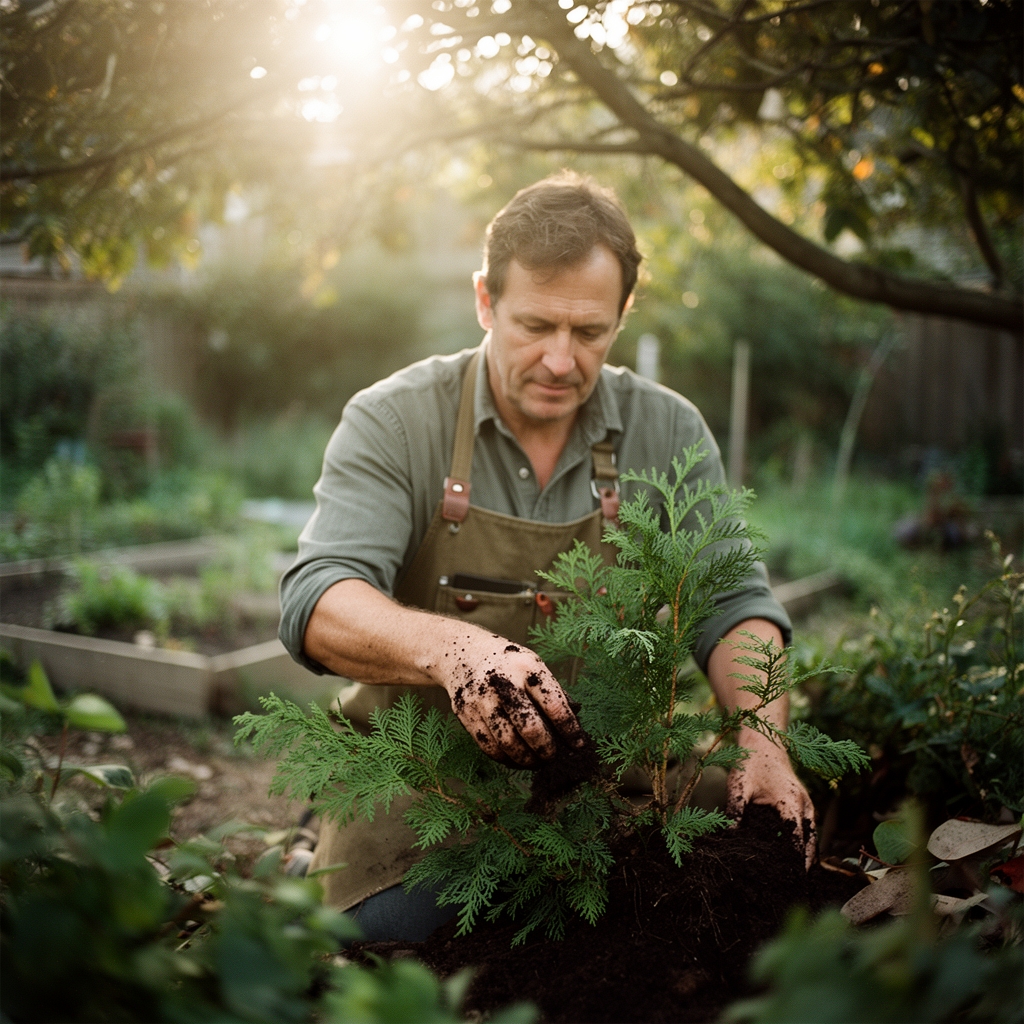
Sowing: Cedar seeds require 30 to 60 days of cold stratification at 34 to 38 degrees Fahrenheit. Mix seeds with moist peat moss at a 1:4 ratio in sealed bags. Germination occurs in 14 to 28 days at 68 degrees Fahrenheit under 16-hour photoperiods. Seedlings emerge with two linear cotyledons and reach 4 inches in 12 weeks.
Pro-Tip: Soak seeds in 200 ppm gibberellic acid solution for 24 hours before stratification to improve germination uniformity by 35%.
Transplanting: Move seedlings to individual 4-inch pots when the first true foliage appears. Dig planting holes three times wider than the root ball but no deeper. Position the root collar at grade level to prevent crown rot. Backfill with native soil, eliminating air pockets by settling with water rather than tamping.
Pro-Tip: Score the outer 1/4 inch of root-bound container stock with a sterile blade in four vertical lines to redirect circling roots outward and prevent girdling.
Establishing: Apply 1 inch of water weekly for the first growing season, delivered in two 30-minute sessions. Install drip emitters 6 inches from the trunk, expanding the irrigation zone outward as roots develop. Maintain a 3-inch layer of organic mulch in a 36-inch diameter circle, keeping material 4 inches away from bark to prevent moisture accumulation.
Pro-Tip: Prune lower branches at 45-degree angles when trunks reach 2 inches diameter to encourage clear, knot-free lumber in the lower 8 feet. Auxin distribution shifts upward, accelerating apical dominance.
Troubleshooting
Symptom: Browning foliage on interior branches during late summer.
Solution: Normal senescence of shaded, aged foliage. No intervention required. Interior needles shed after three to five years.
Symptom: Flattened, discolored foliage with fine webbing.
Solution: Spider mites (Oligonychus ununguis) thrive in hot, dry conditions. Apply horticultural oil at 2% concentration, covering all foliage surfaces. Increase irrigation frequency to raise humidity around the canopy.
Symptom: Cankers oozing amber resin on trunk or branches.
Solution: Seiridium or Botryosphaeria fungi enter through wounds. Prune infected branches 6 inches below visible symptoms. Sterilize tools between cuts with 70% isopropyl alcohol.
Symptom: Stunted growth with chlorotic new foliage.
Solution: Nitrogen deficiency in sandy soils with low organic matter. Apply blood meal at 1 pound per 100 square feet or urea at 0.25 pounds per 100 square feet. Symptoms reverse in 21 days.
Symptom: Wilting despite adequate soil moisture.
Solution: Phytophthora root rot in poorly drained sites. No chemical cure exists. Remove affected trees and improve drainage with French drains or raised beds before replanting resistant species.
Maintenance
Irrigate established cedars with 1 inch of water every two weeks during drought periods. Deep watering promotes root growth to 36-inch depths. Fertilize every third spring with 10-10-10 granular blend at 1 pound per inch of trunk diameter, broadcast beneath the drip line.
Prune dead or crossing branches in late winter when sap flow slows. Maintain a single leader on young trees by removing competing stems within 18 inches of the apex. Avoid shearing, which creates dense outer foliage that traps humidity and invites disease.
Monitor for bagworms (Thyridopteryx ephemeraeformis) in June. Hand-pick bags or apply Bacillus thuringiensis var. kurstaki at 0.5 ounces per gallon when larvae are active. Deer browse young foliage in winter; install 8-foot fencing or apply capsaicin repellents at two-week intervals.
Test soil pH every three years. Apply elemental sulfur at 1 pound per 100 square feet to lower pH by 0.5 units if readings exceed 7.5. Gypsum improves soil structure in compacted clay without altering pH, applied at 40 pounds per 1,000 square feet.
FAQ
Which cedar species resists rot longest?
Western Red Cedar contains the highest concentrations of thujaplicin and thujic acid, providing 25 to 30 years of decay resistance in ground contact without chemical treatment.
Can cedar furniture remain untreated outdoors?
Yes. Natural oils weather to silver-gray patina in 18 to 24 months. Apply penetrating oil annually to maintain original color or let patina develop for reduced maintenance.
How long until harvested cedar produces furniture-grade lumber?
Western Red Cedar reaches 12-inch diameter in 40 to 60 years. Eastern White Cedar requires 60 to 80 years. Incense Cedar matures in 50 to 70 years under optimal conditions.
Do all cedars repel insects equally?
No. Aromatic Red Cedar (Juniperus virginiana) produces the most potent insect-repelling volatile oils. True cedars (Thuja species) offer moderate repellency through thujaplicins rather than aromatic compounds.
What causes cedar to split after milling?
Rapid moisture loss creates unequal shrinkage between heartwood and sapwood. Air-dry lumber to 12% moisture content over six months before joinery. Stack boards with 1-inch stickers every 16 inches, weighted evenly.