9 Growth Benefits of Specialized Succulent Fertilizer
Succulents thriving in shallow pots often display stunted rosettes and pale, stretched leaves despite full sun exposure. The cause lies beneath the surface: depleted mineral reserves in fast-draining media. Using a specialized succulent fertilizer restores essential nutrients in ratios that match these plants' evolutionary adaptation to nutrient-poor soils, triggering compact growth, deeper pigmentation, and resilient cell walls that withstand both drought and mechanical stress.
Materials
Specialized succulent formulations maintain NPK ratios between 2-4-7 and 4-4-4, significantly lower in nitrogen than standard houseplant feeds. Organic cactus meal blends (typically 4-4-4) incorporate bone meal for phosphorus, kelp for trace minerals, and composted bark for slow-release nitrogen. Liquid concentrates at 1-7-6 ratios suit monthly feeding schedules during active growth. Granular time-release pellets (3-4-5) embedded in the top inch of substrate provide steady nutrition for 60 to 90 days.
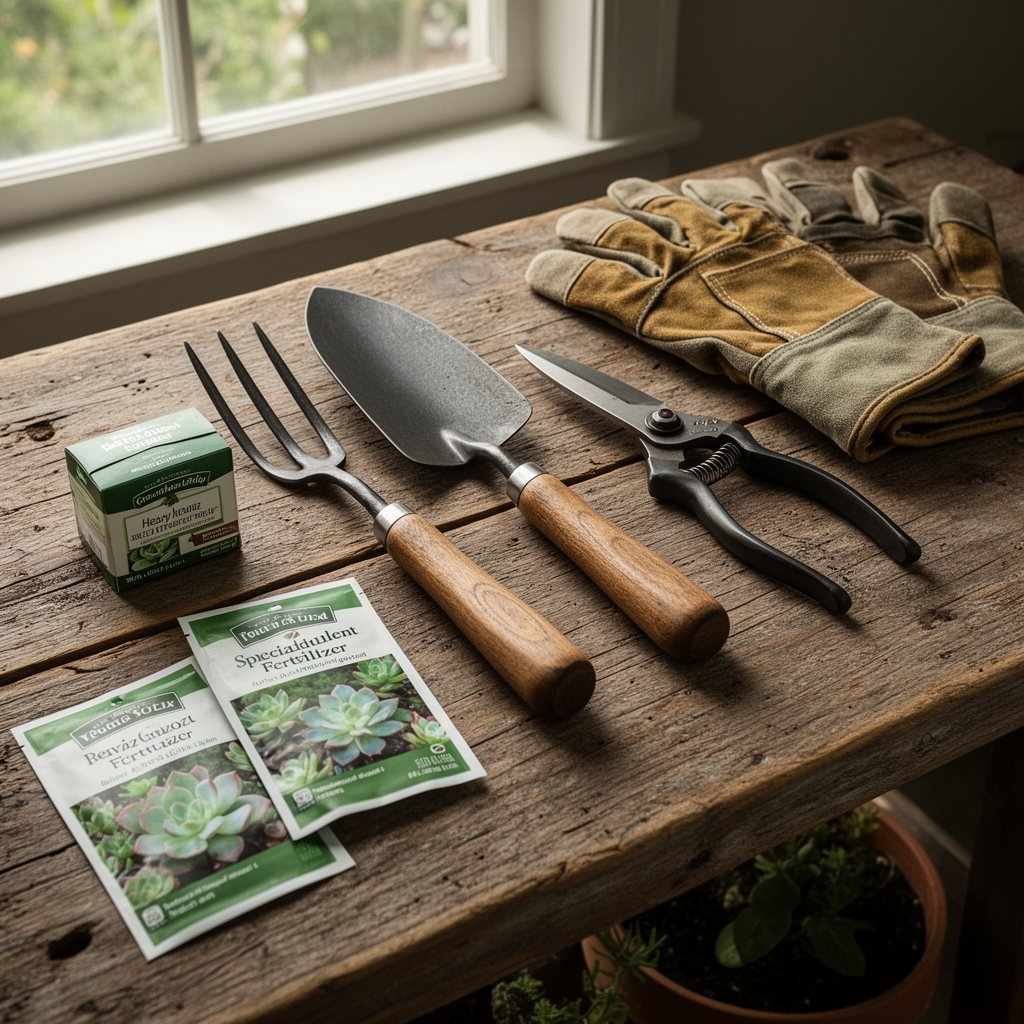
The ideal pH range for succulent fertilizer solutions sits between 6.0 and 6.5, matching the slightly acidic conditions that optimize cation exchange capacity in pumice and perlite-heavy mixes. Chelated micronutrients (iron, manganese, zinc) prevent lockout in these inert substrates. Calcium and magnesium supplements at 2:1 ratios strengthen cell walls without triggering salt buildup. Water-soluble powders should dissolve completely at one-quarter to one-half the manufacturer's recommended strength to avoid osmotic stress in shallow root systems.
Timing
Application schedules align with photoperiod and temperature thresholds rather than calendar months. In USDA Hardiness Zones 9 through 11, begin fertilization when nighttime temperatures stabilize above 50°F, typically March through October. Zones 5 through 8 require a condensed feeding window from late April through early September, ending six weeks before the first expected frost date.
Indoor collections under grow lights receive dilute feeds year-round, with concentrations reduced by half during November through February when ambient light intensity drops below 2,000 foot-candles. Sempervivum and Sedum species grown outdoors in Zones 4 and 5 receive a single spring application in late April, then no further feeding to harden growth before winter dormancy. Warm-season growers like Euphorbia and Adenium require biweekly feeding from May through August in temperate zones.
Phases
Sowing

Germinating seedlings receive no fertilizer for the first four to six weeks post-emergence. Initial cotyledons contain sufficient stored energy. Once true leaves develop and measure 5 to 8 millimeters across, introduce a 1-10-5 solution diluted to one-eighth strength every 14 days. This phosphorus-heavy ratio encourages root proliferation without forcing excessive top growth that would strain immature vascular systems.
Pro Tip: Drench germination trays with mycorrhizal fungi spore suspension (500 spores per milliliter) at the two-week mark. The symbiotic relationship increases phosphorus uptake efficiency by 40 percent in volcanic substrate mixes.
Transplanting
Three days before moving rooted cuttings or seedlings into individual containers, withhold water to reduce turgor pressure and minimize root damage. Incorporate granular 3-4-5 fertilizer into the potting mix at a rate of one teaspoon per quart of substrate. This pre-charged medium provides nutrition during the establishment phase without direct root contact that could cause chemical burn.
Pro Tip: Dust root balls with rooting hormone powder containing 0.1 percent indole-3-butyric acid (IBA) immediately before potting. This auxin distribution accelerates lateral root formation by 60 percent within 21 days.
Establishing
Six weeks after transplanting, begin liquid feeding at half-strength with 2-7-7 formulations every 21 days. Monitor new growth for color and compactness. Echeveria and Graptoveria genera should produce leaves with minimal spacing between nodes, measuring less than 3 millimeters for mature rosettes. Excessive internode elongation signals nitrogen overload; reduce frequency to monthly intervals and dilute solutions to one-quarter strength.
Pro Tip: Apply foliar sprays of kelp extract (diluted to 1 tablespoon per gallon) during early morning hours when stomata open fully. Absorption through leaf surfaces delivers cytokinins that stimulate compact branching patterns.
Troubleshooting
Symptom: Lower leaves turn translucent yellow and detach with gentle touch.
Solution: Nitrogen toxicity from over-fertilization. Flush containers with distilled water at three times the pot volume. Resume feeding at one-eighth strength after 30 days.
Symptom: Brown, corky lesions appear on leaf margins and stem bases.
Solution: Excess salts from fertilizer accumulation. Leach substrate monthly with pure water. Switch to organic formulations with lower electrical conductivity (EC below 1.5 mS/cm).
Symptom: New growth emerges pale green with red or purple tinting absent in normally pigmented species.
Solution: Phosphorus deficiency. Apply bone meal top-dressing at one tablespoon per 6-inch pot. Drench with liquid 2-10-5 solution weekly for three applications.
Symptom: Leaf tips brown and desiccate despite adequate watering.
Solution: Potassium deficiency exacerbated by high calcium content. Use sulfate of potash (0-0-50) at one-quarter teaspoon per gallon every 14 days for two months.
Symptom: Stem sections soften and collapse at soil line.
Solution: Fungal infection (Pythium or Phytophthora) encouraged by excess nitrogen. Remove affected tissue with sterilized blade. Drench remaining healthy plants with copper fungicide. Eliminate fertilization for 60 days.
Maintenance
Water thoroughly when substrate dries completely, approximately every 10 to 14 days in active growth. Apply 4 ounces of water per 4-inch pot diameter, allowing complete drainage. During winter dormancy, extend intervals to 21 to 28 days and reduce volume by half.
Refresh top inch of substrate annually each spring, mixing in one teaspoon of granular 4-4-4 fertilizer per 6-inch container. Repot completely every 24 to 36 months when roots occupy more than 80 percent of container volume. Prune dead lower leaves monthly to prevent fungal colonization and improve air circulation around stem bases.
Rotate containers 90 degrees weekly under unidirectional light sources to prevent phototropic leaning. Maintain ambient temperatures between 65°F and 80°F during growth periods. Reduce to 50°F to 60°F for eight weeks in winter to trigger flowering in Mammillaria and Gymnocalycium species.
FAQ
How often should I fertilize succulents?
Feed every 21 days from April through September using half-strength liquid formulas. Suspend feeding entirely from October through March for temperate-zone collections.
Can I use regular houseplant fertilizer on succulents?
Standard 20-20-20 formulations contain excessive nitrogen that forces weak, elongated growth. Succulent-specific products with NPK ratios below 5-5-5 prevent etiolation.
What causes white crust on soil surface after fertilizing?
Mineral salt accumulation from fertilizer residue. Scrape away top half-inch of substrate and replace with fresh mix. Leach pots with distilled water monthly.
Do succulents need fertilizer in winter?
No. Dormant plants cease active metabolism and cannot process nutrients. Fertilizing during dormancy causes root burn and increases disease susceptibility.
Why are my fertilized succulents still growing slowly?
Insufficient light intensity or incorrect substrate pH. Verify 4,000 to 6,000 foot-candles minimum and adjust soil pH to 6.0-6.5 using sulfur or lime amendments.